Stories from the opal fields
The Opal Rush: How Coober Pedy Began
A boy's 1915 find did not create one rush but three. Follow Coober Pedy from camel-carted water and Tottie Bryant to migrant miners and the blower.
Coober Pedy’s opal rush began with almost nobody rushing anywhere.
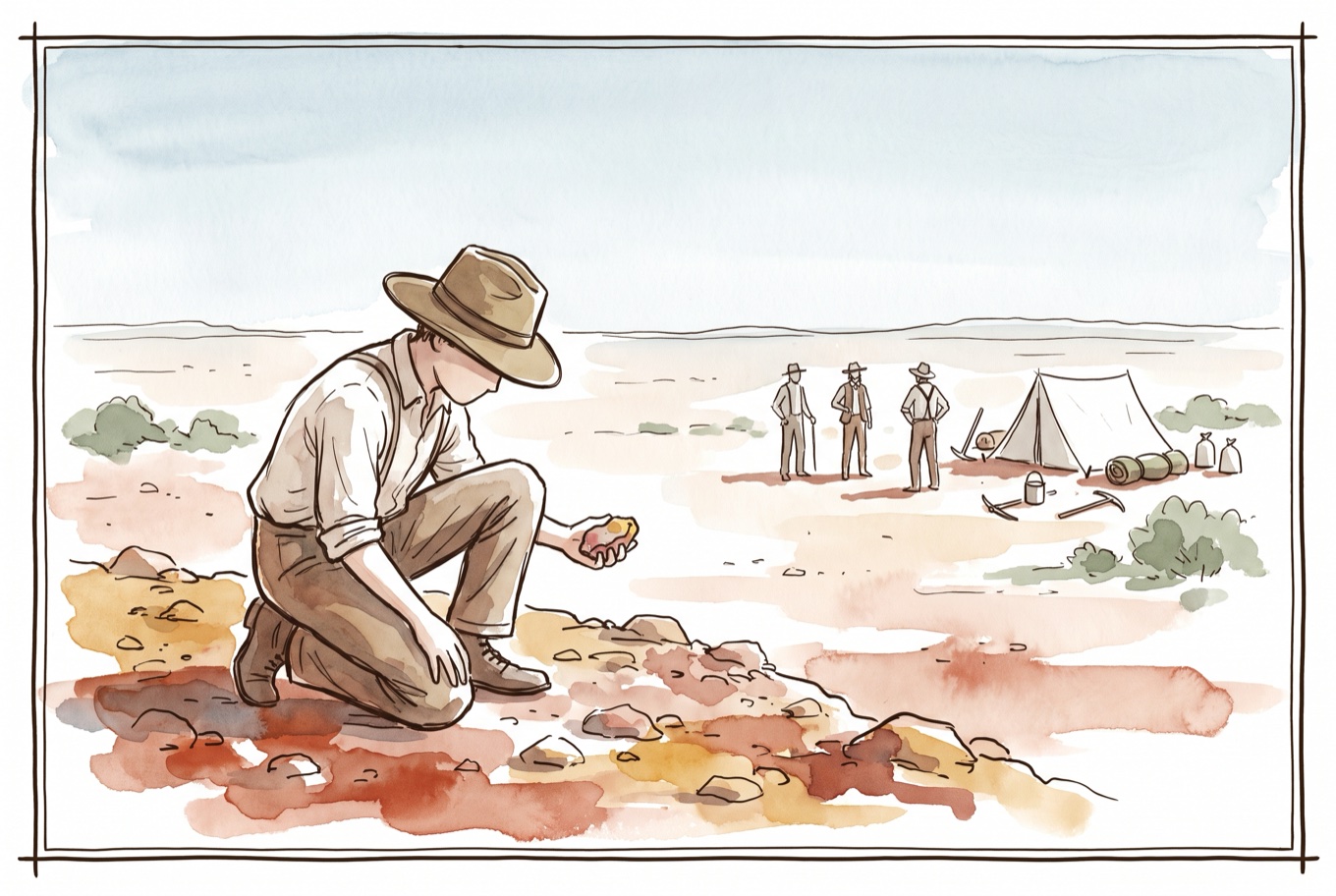
On 1 February 1915, fourteen-year-old Will Hutchison walked away from a desperately dry prospectors’ camp on the Stuart Range. He came back with water and pieces of opal. Eight days later the first claim was pegged. Ten days after that, the party left the field because the heat and lack of water made staying there impossible.
That is the first surprise in Coober Pedy’s origin story: the discovery did not trigger an instant stampede. The town was made by several rushes, years apart, and every one depended on more than colour in the ground. It needed rain, transport, a market for opal and people stubborn enough to begin again after the field had nearly emptied.
The mining story has a starting date; Country does not. Coober Pedy is on the traditional lands of the Antakirinja Matu-Yankunytjatjara people. Aboriginal knowledge, movement and work across this region long predate 1915 and run through the opal story, even where early written accounts barely acknowledged them.
A boy finds what the gold men missed
Late in 1914, the New Colorado Prospecting Syndicate headed north looking for a reported gold reef. The party comprised Will, his father James “Jim” Hutchison, P. J. Winch and M. McKenzie. They travelled by camel and spent about fourteen weeks finding no payable gold.
Water became the urgent problem. In Jim Hutchison’s later account, the adults went to search for it and instructed Will to remain with the camp. He did not. The teenager went exploring and found both a water source and loose pieces of precious opal on the surface - floaters, in mining language.
The syndicate pegged its first opal claim on 9 February, followed by search leases on the 18th. On 19 February it retreated towards William Creek. The party had proved that an opal field existed, but not that people could live on it.
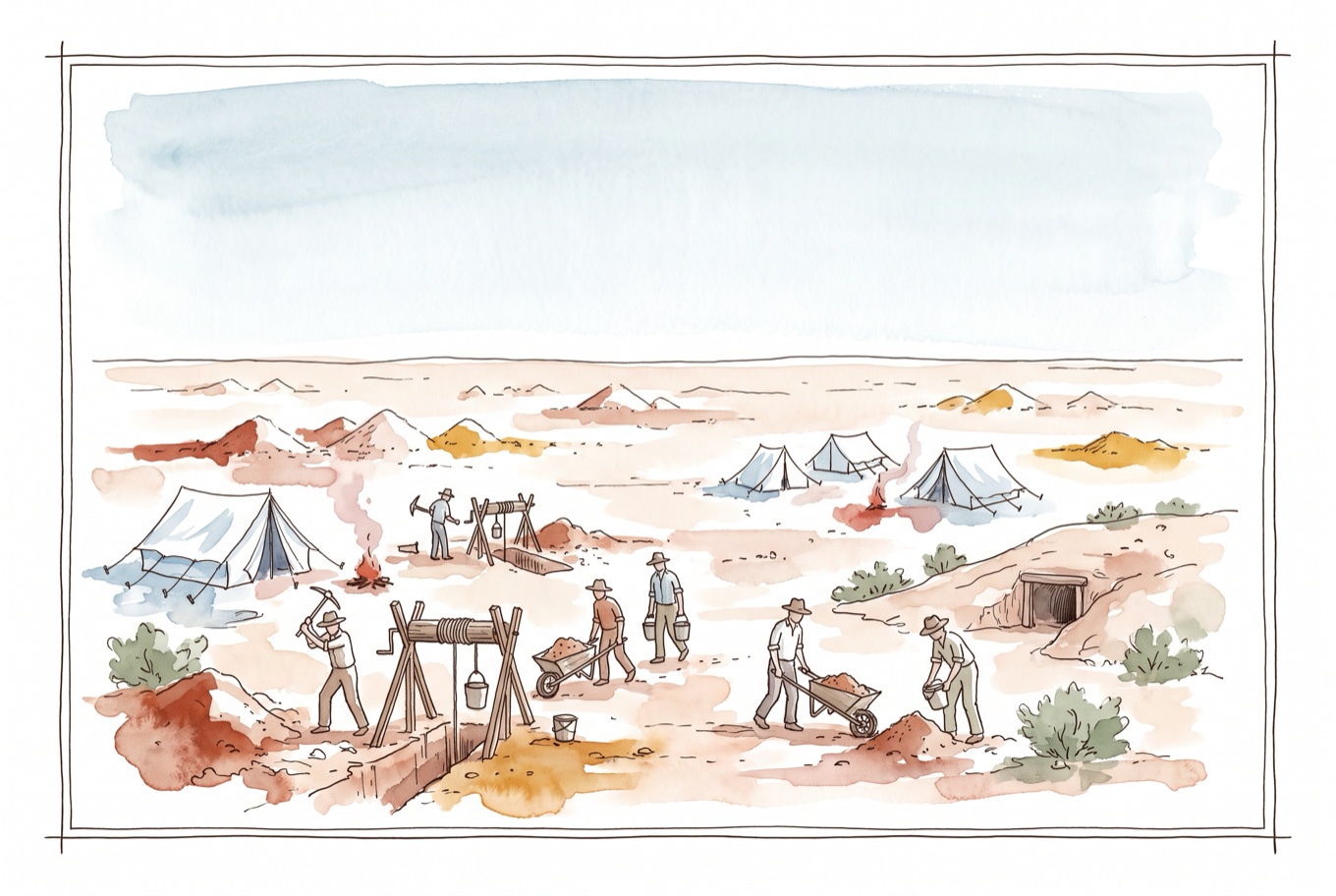
Others supplied that proof. Jim and Dick O’Neill, joined by Fred Blakeley, found payable ground around Big Flat later in 1915. By 1916 it was the field’s main working: individual miners sinking shafts with picks, hauling mullock in buckets and watching for a thin line of colour in pale sandstone. The Stuart Range Opal Field had begun, quietly.
The rush arrives four years late
The first arrivals were a trickle. Government geologist L. Keith Ward inspected the field in 1916, but isolation still defeated most would-be miners. Completion of the Trans-Australian Railway in 1917 brought the country within somewhat easier reach. Railway workers tried their luck; after the First World War came returned soldiers, and in 1919 miners arrived from Broken Hill during bitter industrial conflict there.
Then rain fell. Reports reaching Adelaide claimed opal was “sticking out of the ground” and “being dug out with knives”. The State Library’s historical newspaper index notes that the city reader could be forgiven for imagining fortune required little more than turning up.
It did not. A miner still had to reach an isolated field, bring food and water, sink through unforgiving ground and find a buyer before the opal market changed. But by 1920, after good rain, the population had climbed to a few hundred. There was a store, a post office and a Progress Committee: the beginnings of a town.
The post office needed an official place name. At a special meeting on 26 June 1920, the committee voted: Coober Pedy received 16 votes, ahead of Opal Range with 12, Hutchison with five and Gemville with three. The meaning and even the language behind the winning name remain debated; we explore that knot in What Does ‘Coober Pedy’ Mean?.
Water was the real currency
Finding opal was uncertain. Finding water was worse.
In the 1920s, water could cost about £3 per 100 gallons and travel roughly 40 miles by camel. Used water was allowed to settle, boiled and used again. Prospectors drilled for a local supply from 1919 to 1921, but the groundwater was often too salty to drink.
The answer was an immense underground tank, fed by a surface catchment and built in 1921-22 to hold about 500,000 gallons of rainwater. In a perfect Coober Pedy detail, the new reservoir did not fill completely until 1926. Water, not geology, set the field’s pace. The struggle would continue through bores, cartage and eventually desalination; it has a story of its own.
The same extremes shaped the town’s defining architecture. Miners cut rooms into stable sandstone, where the temperature remained around 22-23°C while the surface baked or froze. Returned soldiers are often credited with bringing trench living to the field, but the chronology is untidier and more interesting: Dick O’Neill and Fred Blakeley had already dug an underground home near Big Flat in December 1915. Veterans may have helped popularise dugouts; they did not invent them here.
A luxury stone meets the Depression
An opal field is tied to the price of something nobody strictly needs. When the market is strong, colour can turn a miner’s week around. When buyers disappear, even rich ground can be worthless.
Prices collapsed during the Great Depression. Production slowed almost to a halt and stayed low through the Second World War. By 1946, only about 34 miners remained on the field. Coober Pedy’s first rush had run down.
Its revival began with an Aboriginal woman.
In late 1945, Tottie Kendall, also remembered as Tottie Bryant, found rich, shallow opal at Eight Mile with her partner, Charlie Bryant. They kept the find quiet for as long as they could and worked several parcels close to the surface, according to local histories. Word escaped in 1946, and the second rush began.
Tottie’s place in the story matters for more than the strike itself. Aboriginal people were not simply bystanders or occasional noodlers in a white industry. Oral histories and academic research record Aboriginal miners owning and working claims, digging for others, sorting, buying and selling opal, and choosing a small-scale industry that offered unusual independence. The surviving written record is incomplete; their work was not.
Eight Mile kept changing the field. In 1957 an Italian partnership sank a shaft about 15 metres deep and found high-quality opal, helping demonstrate that the future was not only in shallow hand workings. The next rush would go deeper, move faster and speak in many languages.
The third rush spoke many languages
In the late 1960s, stronger overseas demand met a new population of postwar migrants. Miners from Italy, Greece, Croatia, Serbia and elsewhere brought mechanical skill, mining experience and the same appetite for independence that had drawn earlier prospectors.
Opal offered a rare proposition: work your own claim, trust your reading of the ground and keep the reward if the gamble paid. The field did not erase cultural differences; it planted them side by side. Clubs, food, churches and family networks grew around the mines, making Coober Pedy one of Australia’s most distinctive towns of many nations.
Machinery changed what those miners could attempt. Compressors and powered winches reached deeper levels. Calweld drills opened shafts; tunnelling machines attacked the face; bulldozers moved ground that hand miners could never have shifted.
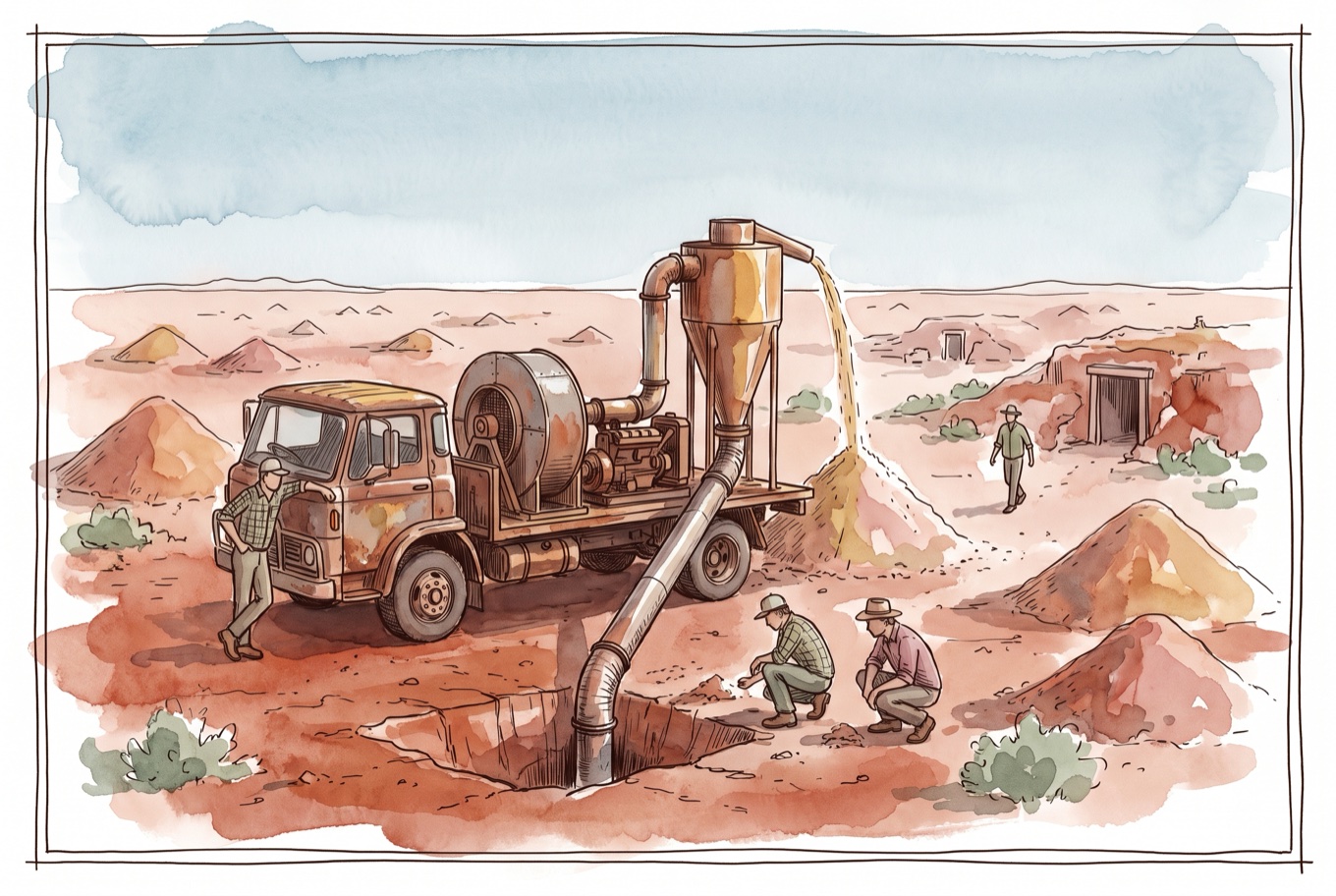
The most characteristically Coober Pedy invention was the blower - which is really an enormous vacuum. Around 1968, Italian mechanic Mario Pagnon mounted a powerful suction fan and diesel engine on a truck and drew mullock up through a wide pipe. The fan discharged dirt and stones in a plume visible for miles, inspiring the name. Murray Joynt and other local builders added hoppers and cyclones, then kept modifying fans, pipes, motors and old trucks until the machine became the field’s workhorse.
Mechanisation, migration and international demand turned opal into a multimillion-dollar industry through the 1960s and 70s. Prices peaked around 1979; by 1980 Coober Pedy’s population had passed 3,000. The once-empty field now had workshops, clubs, churches, a school and the improvised machinery of a town that preferred solving its own problems.
The rush never really ended
Mining is quieter now, and tourism has become central to the town, but Coober Pedy still reads like a record of successive rushes. A hand-dug shaft belongs to the first. Eight Mile marks the second. A truck with a steel hopper and a forest of pipe announces the third. The languages, clubs and underground homes tell you who stayed.
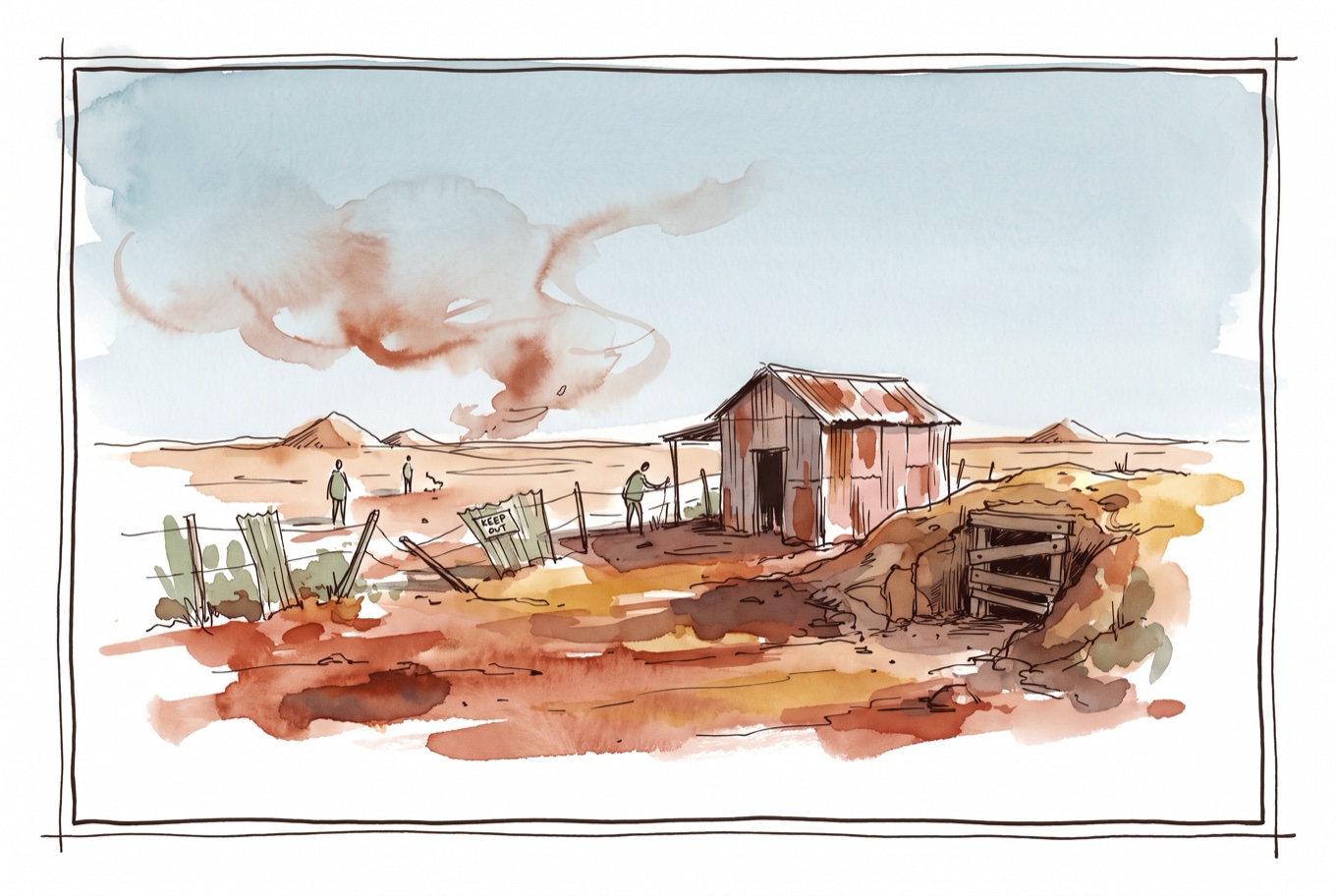
You can walk through genuine early workings at the Old Timers Mine, see mining and community history at Umoona Opal Mine & Museum, visit the Eight Mile field, or try surface fossicking at the public noodling area. Do not wander onto working fields or across unmarked ground: Coober Pedy’s open shafts are history you can fall into. Read the outback safety guide first.
The teenager’s 1915 floater did not build a town by itself. Coober Pedy came from the people who returned after the first camp failed, after the market collapsed and after every easy answer ran out. The real rush was not a moment. It was the decision, repeated across a century, to look again.
Sources and further reading
- South Australian Heritage Council assessment of Crocodile Harry’s Dugout: mining, water and dugouts
- District Council of Coober Pedy: town history
- Jim Hutchison’s 1938 account, “How We Found Coober Pedy,” via Trove
- State Library of South Australia: “Coober Pedy” place-name entry and newspaper references
- University of Adelaide: Michael Harding’s history of Aboriginal engagement in the opal industry
- ABC: the under-recorded history of Coober Pedy’s Aboriginal opal miners
- Sue Britt, “The Coober Pedy Blower Story,” Australasian Mining History Association
- SA Energy & Mining: opal geology and mining methods
Historical accounts vary on some details. This article follows the documentary spelling Hutchison, the 1 February 1915 discovery date, the 26 June 1920 naming vote, and describes Tottie’s find as late 1945 with the resulting rush in 1946.